444 8 440Request a review
Crane Components and Drive Units manufactured by ABRA Crane
Home › Industrial Cranes and Lifting Equipment › Crane Components and Drive Units

Crane Components and Drive Units

Two cranes with the same rated capacity can wear out on completely different schedules. The reason is usually in three assemblies: the hoist unit, the travel drives and the end carriages. We build ours, and we size them to the duty of the crane they go into.

Since 2004manufacturing in İzmir
16,000m² plant, İzmir
FEM 1Bm–5m / ISO M3–M8duty class range
Founded 2004In-house manufacturingEN · FEM · ISO designCE marked2,500+ cranes installed

What a crane component actually is

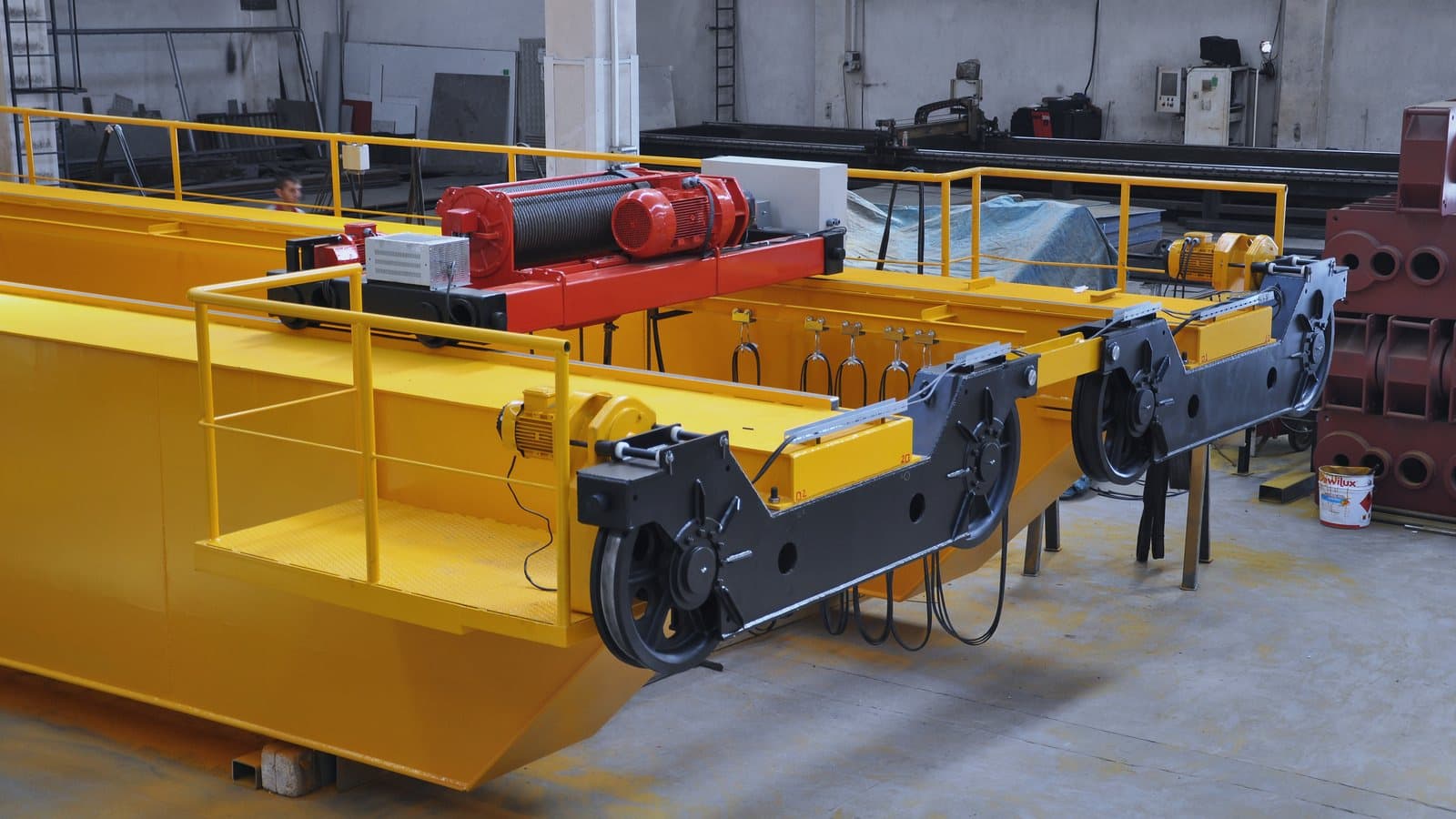
A crane is three working assemblies bolted to a steel structure. The hoist unit is the machine that lifts: motor, drum, rope and hook block. The travel drives move the bridge along the runway and the trolley across it. The end carriages carry the whole bridge on its wheels and put the load into the runway rail.

Everything else on a crane, the structure, the control system and the energy supply, is built around what those three assemblies can take.

What these three assemblies decide

Duty class is set assembly by assembly. Under FEM and ISO classification the group is assigned to a mechanism, not handed down from the crane, and it can come out differently for the hoist and for the travel drives on the same machine. A hoist rated FEM 2m / ISO M5 works at 40% ED and 240 starts an hour; one rated FEM 1Am / ISO M4 works at 30% ED and 180 starts an hour. Same tonnage, different machine. Getting that wrong is one of the common reasons a crane ages faster than the plant expected. Duty class guide →

Travel drives set what the structure absorbs. Inverter-controlled travel gives a soft start and a soft stop, so the shock that a hard start pushes into the girder, the wheels and the runway rail is taken out of the cycle, and the operator can place a load without hunting for it.

End carriages set the wear. The wheel group is where the bridge meets the rail, so wheel life, rail life and how square the crane runs are all decided at this assembly. It is also the assembly that has to be right on day one: a wheel group is not something a plant wants to be adjusting once production has started.

The component families we build

Hoist unit — the machine that lifts

Wire rope hoist units from 250 kg to 160 t as a standard selection range, above which we engineer per project, built as complete machines rather than assembled from a catalogue: drum, rope, reeving and motor are chosen together against the load spectrum and the duty class. Reeving arrangements 2/1 · 4/1 · 6/1 · 8/1 · 12/2. Hoisting is stepless and inverter-controlled with micro-speed positioning. Lifting machines →

End carriages and wheel groups

Also called end trucks. Supported and suspended arrangements, built to the span, the wheel load and the runway of the crane they carry. Overload protection within the scope of EN 14492-2, an overload switch working with a load cell, is standard on our cranes.

Operator cabins

Fixed and travelling cabins, built in the same plant, so the sightline, the control layout and the environment inside the cabin are engineered with the crane and not fitted to it afterwards. Operator cabins →

Explosion-protected components

In a classified area the component question becomes a certification question. For gas Zone 1–2 and dust Zone 21–22 we build the lifting machine and, in this case, its gearbox in our own plant, with explosion-protected motors and electrical equipment, non-sparking bronze-plated hooks, anti-collision equipped trolleys and static discharge. Certification is carried out by a third-party body, product by product, against the code in your project. Explosion-protected cranes →

Component data

Wire rope hoist capacity250 kg – 160 t
Duty class — crane levelFEM 1Bm – 5m · ISO M3 – M8
Duty class — machine levelFEM 1Am / ISO M4 · FEM 2m / ISO M5
Operating time ratio30% ED · 180 starts/h · 40% ED · 240 starts/h
Hoisting speedStepless, inverter-controlled, 2.3 – 8 m/min by series, reeving and duty class, with micro-speed positioning
Trolley travel speedStepless 4–16 m/min · fixed 16 or 20 m/min
Lifting height4 – 28 m
Reeving2/1 · 4/1 · 6/1 · 8/1 · 12/2
Drum diameterØ150 · Ø190 · Ø217 · Ø270 · Ø297 · Ø323 · Ø348 mm
Wire ropeØ6 – Ø18 mm · 6×36 WS and 18×7 construction · 1960 N/mm²
Hoisting motor0.25 – 15 kW
Trolley wheel centres246 – 1100 mm
Power supply380–415 V / 50 Hz · 60 Hz for export
Protection · ambientMotor and panel IP54/55 · −10 … +50 °C
Bridge travel speedInverter-controlled, set per project

Values are the standard build. Capacity, span, wheel load and duty class are confirmed per project before anything is priced.

What we build and what we integrate

Claiming to make everything would be easy to write and easy to disprove, so here is the actual line.

Built in our plant in İzmir: the lifting machine, the end carriages and wheel groups, the crane structure, and the operator cabin. In Ex-Proof work the gearbox is ours as well, and it is certified as part of that build.

How the steelwork is qualified. Welded structures are executed to EN 1090, execution class EXC3, with welding quality requirements to EN ISO 3834-2, welding procedures and welder qualifications recorded (WPS / WPQR), and non-destructive testing by visual, magnetic particle, penetrant and ultrasonic methods. Runway and rail tolerances follow ISO 12488-1, runway structures EN 1993-6, and the busbar to EN IEC 60204-32 with panels to EN IEC 61439-1 / -6. Cranes are CE marked under 2006/42/EC, 2014/30/EU, 2014/35/EU and 2000/14/EC; Machinery Regulation (EU) 2023/1230 applies from 20 January 2027 and our compliance work for it is complete.

Specified and integrated under our own engineering: the inverter drives, the radio and pendant control, the overload electronics, and the busbar and festoon energy supply.

The reason this line matters is practical. When the assembly that carries the load is drawn, cut and machined here, a decision about brake specification or cable class is ours to take against the conditions on your site. And when a part is needed years later, its drawing, its dimensions and its material specification are on file at the works that made it. Manufacturing capability → · Spare parts →

Applications

Where these components end up

The same three assemblies, sized differently, go into every crane we build: double girder overhead cranes, single girder overhead cranes, gantry and semi-gantry cranes, process cranes and Explosion-protected cranes. Control and energy supply are covered on crane control systems.

FAQ

Frequently asked questions

What is a crane end carriage?

The end carriage, also called an end truck, is the assembly at each end of the bridge that carries it on the runway rail. It holds the travel wheels, the travel drive and the buffer connection, and it is where wheel and rail wear is decided.

Does ABRA manufacture its own crane components?

The lifting machine, the end carriages and wheel groups, the steel structure and the operator cabin are built in our own plant in İzmir. Inverter drives, control equipment and energy supply are specified and integrated under our engineering. In Ex-Proof work the gearbox is also our own manufacture and is certified as part of that build.

Can the hoist have a different duty class from the crane?

Yes. Under FEM and ISO classification the duty group belongs to the mechanism, so a hoist and a travel drive on the same crane can sit in different groups. This is why the load spectrum and the number of cycles matter more than the tonnage when a component is being sized.

Will spare parts still fit in ten years?

For the assemblies we manufacture, the drawing, the dimensions and the material specification stay with us, so a replacement is made to the original build. Standard items are held in stock; for a special build we set out the critical parts list in the quotation so you can decide what to hold on site.

What do you need from me to size a component?

Capacity, span, lifting height, how many cycles a shift, and the environment — temperature, dust, and whether the area is classified. Those five answers settle the duty class, and the duty class settles the component.

Get a recommendation

Tell us what the crane has to do

Send the capacity, the span, the cycles and the environment. An engineer confirms the duty class and the component sizing with you before anything is priced — no obligation.

Or call 444 8 440

Request a technical review

Your details are used only to answer your request

Designed and built to EN, FEM and ISO standards · CE marked · duty class defined per project (our build range: FEM 1Bm–5m / ISO M3–M8) · manufacturing in İzmir since 2004