Mounting decides three things at once: how far the arm can turn, what the floor has to carry, and whether you give up floor space at all. The comparison table is in §Spec tables (7a); the types themselves read like this.
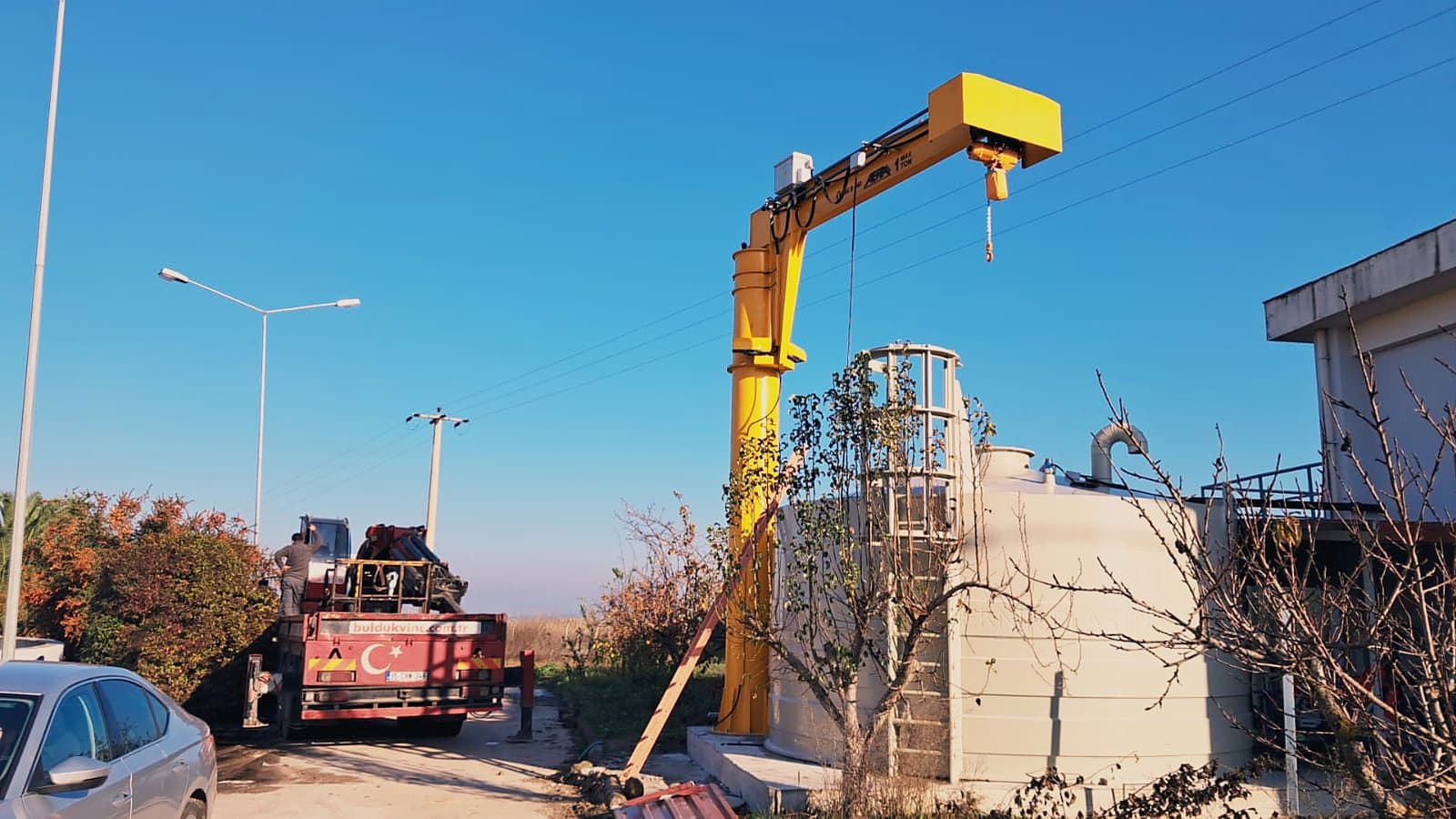
Pillar (column) jib crane — 270°
A steel column is set on its own foundation and the arm slews around it, typically through 270°. It is the standard freestanding workstation machine: it carries its own load path into the floor, so it needs neither a wall nor a runway, and it can be placed exactly where the work happens. What it does need is a foundation sized for the overturning moment, which we calculate for your project.
Freestanding pillar jib crane — n×360°
Where the arm has to turn continuously — feeding a machine from a pallet behind it, then swinging back — the freestanding pillar type rotates through n×360°, full turns without a stop. There is no obstruction behind the column to limit it, so the operator never has to unwind a movement halfway through a cycle.
Floor-mounted jib crane on a base plate
When a new foundation cannot be cast — a finished slab, or a station that may be moved later — the column is bolted to a base plate with anchors instead. The slab then has to carry the same overturning moment, so we issue the base plate and anchor layout with the required concrete class for your structural engineer to verify. Rotation stays at 270° or n×360°, depending on the column type.
Wall-mounted jib crane — 180°
A wall or an existing building column carries the arm on a bracket, and the wall itself limits rotation to about 180°. Nothing stands on the floor, which is why it fits an aisle or a station where a column would be in the way. Full detail is on the wall-mounted jib crane page.
Wall-travelling (console) jib crane
The same wall-carried arm, mounted on a runway so it travels along the wall and serves a long strip beside it. It suits a line of machines spread along the wall. Full detail is on the wall-travelling (console) jib crane page.