
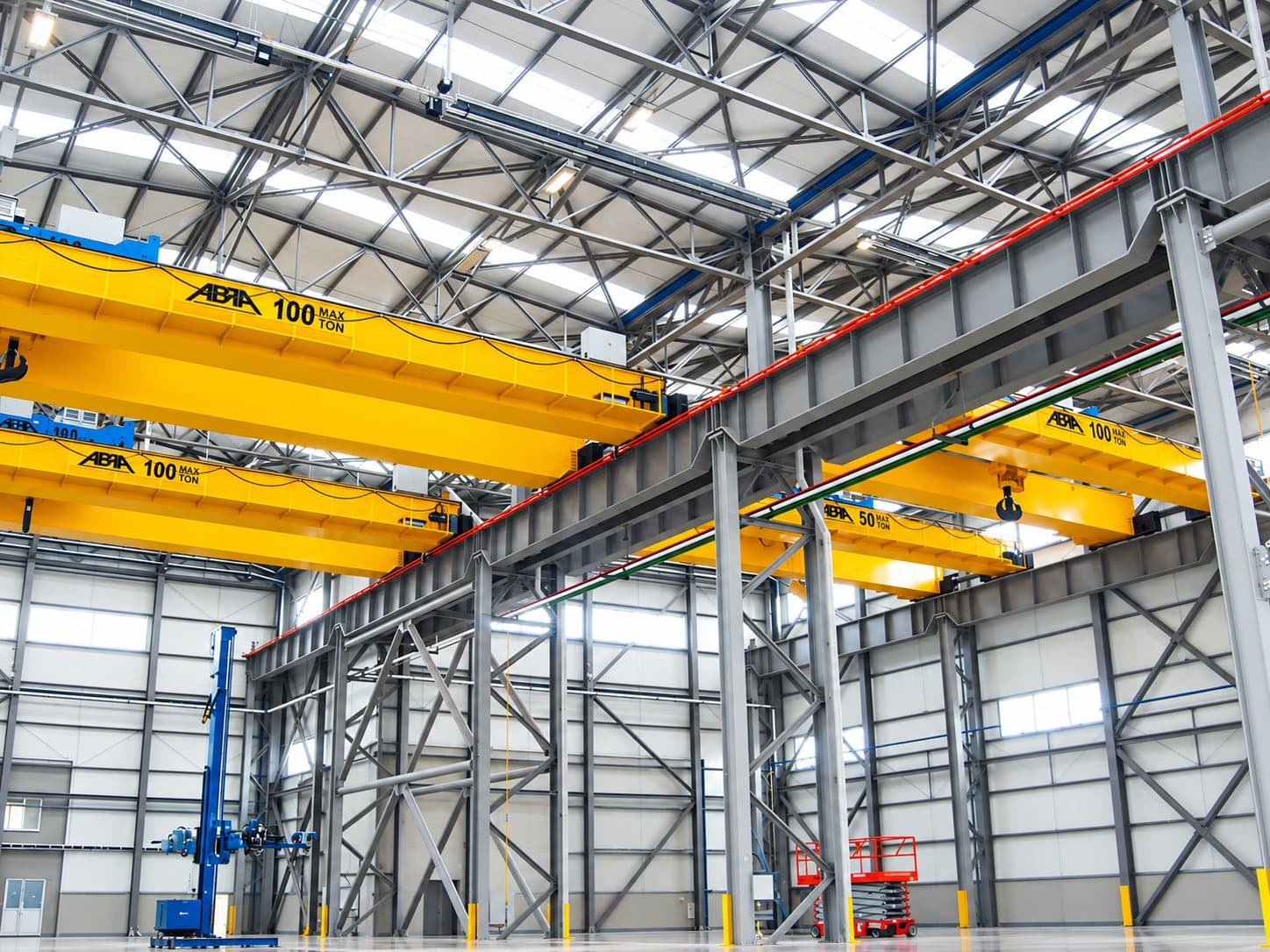
Industrial Cranes and Lifting Equipment
From a 250 kg jib beside a single machine to a 160-tonne double girder crane — engineered to the load, the span and the duty class of the work in front of it. Find the type that fits your building.
Bridge, gantry and jib
Crane systems
Overhead cranes
The head of the range: a bridge that travels a runway and covers the whole working area beneath it. Start here if you are choosing a type.
Overhead cranes →Double girder overhead crane
For loads above 12 tonnes, long spans and continuous duty, with more hook path under the same roof.
Double girder overhead crane →Single girder overhead crane
250 kg to 12 t as a standard selection on 30 m standard spans, with less structure above the load and less weight into the building.
Single girder overhead crane →Gantry cranes
The crane carries itself on legs and rails, so the building carries nothing. Open yards and structures never sized for a runway.
Gantry cranes →Semi-gantry cranes
One end on a wall or column line, the other on a floor rail, where only one side can take a runway.
Semi-gantry cranes →Jib cranes
The lift that belongs to one machine and one radius: 250 kg to 5 t, 2.5 to 5 m of arm, pillar, wall or travelling.
Jib cranes →Engineered to the process
Special and process cranes
Process cranes
Engineered around a production process rather than a building: temperature, exposure, cycle and load spectrum set the design.
Process cranes →Explosion-protected (ATEX) cranes
For classified areas, built so no part of the crane can ignite the atmosphere, with the lifting machine and its gearbox certified out of our own plant.
Explosion-protected (ATEX) cranes →Automated crane systems
Fully automatic positioning, position memory and repeat moves for a cycle that does not change. Fully automatic, in a work area closed to people; safety sensors supervise every move.
Automated crane systems →Components and equipment
Lifting machines and equipment
Hoists and lifting machines
Wire rope hoists from 0.25 t, built and load-tested in our own plant.
Hoists and lifting machines →Transfer cars
Moving loads between lines at floor level where a crane is the wrong instrument.
Transfer cars →Operator cabins
Where the operator needs to see the load from above and be shielded from what is under it.
Operator cabins →Crane components
End carriages, wheel groups, drive units and steel structure, supplied as parts.
Crane components →Crane control systems
Radio remote, pendant, inverter control and anti-sway.
Crane control systems →Crane kits (OEM)
Hoist, end carriages, panel and controls as a package for crane builders and integrators.
Crane kits (OEM) →Which crane type do I need?
Four answers decide the type, and they are usually enough to narrow it to one or two:
- What does it lift, and how heavy is the heaviest lift? Capacity sets the structure before anything else does.
- How far does it have to reach across? Span, and whether your building steel can carry a runway at all.
- How often does it lift, and for how many hours? This is the duty class, and it matters more than capacity — see the duty class guide.
- What is the environment? Heat, dust, chemical exposure, washdown, or a classified zone; each one changes materials, protection and control.
Manufacturing
“From our plant to your line”
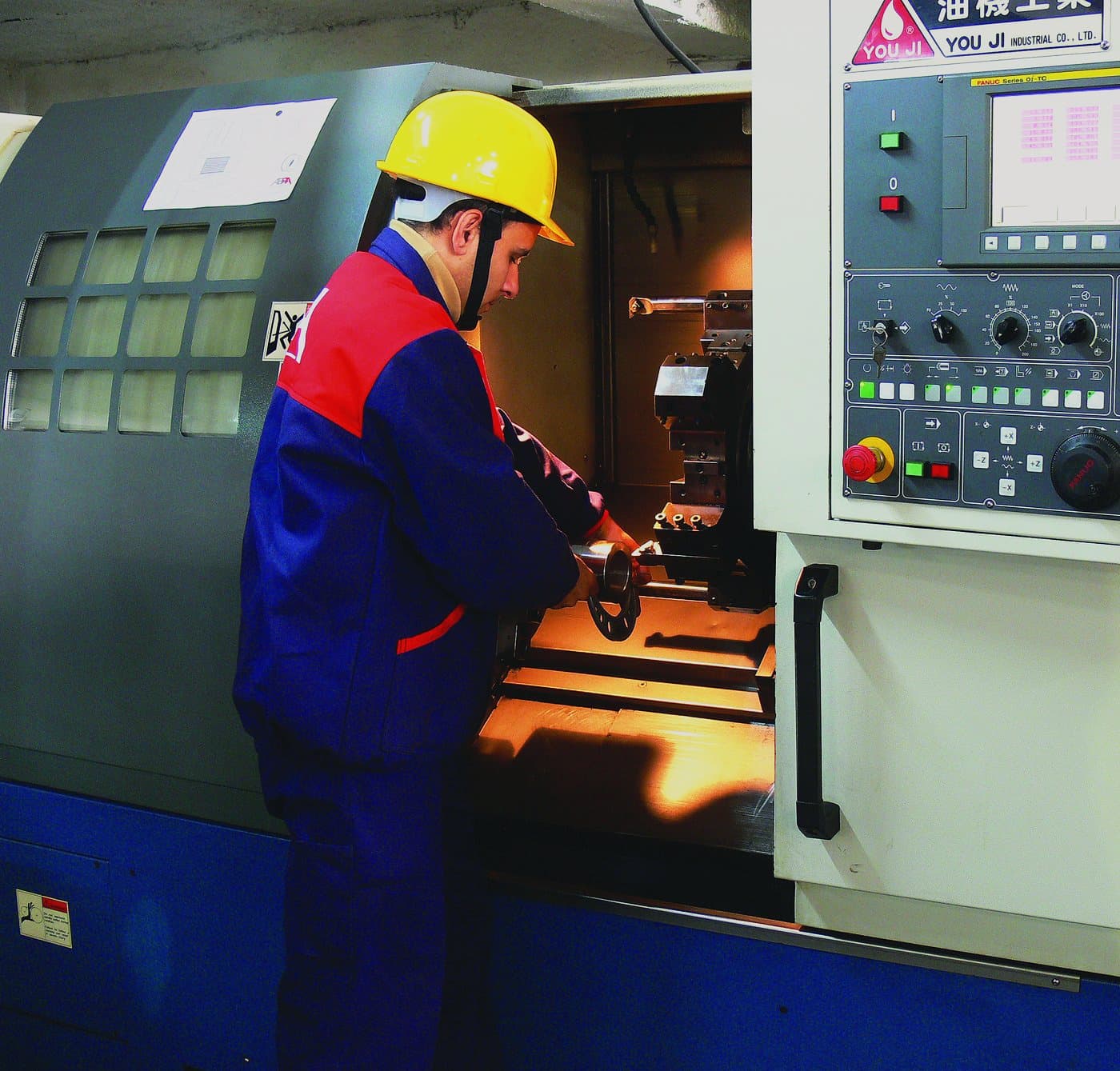

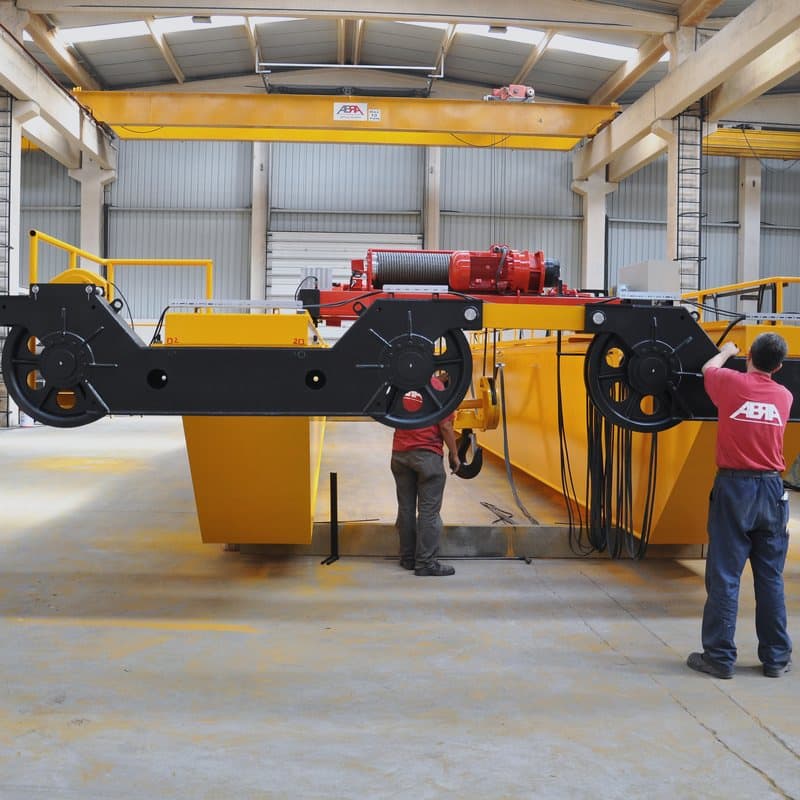
Machines, steel structure, end carriages and wheel groups and operator cabins are built in our plant in İzmir. Manufacturing since 2004 · 16,000 m² · cranes installed across Europe, the Gulf, Africa, Central Asia and Latin America.
Get a recommendation
Tell us what has to be lifted
Send us the load, the span, the cycle and the environment. An engineer confirms the type and the duty class with you before anything is priced — no obligation.
Or call 444 8 440
Designed and built to EN, FEM and ISO standards · CE marked · duty class defined per project (our build range: FEM 1Bm–5m / ISO M3–M8) · manufacturing in İzmir since 2004