444 8 440Request a review
Overhead Cranes manufactured by ABRA Crane

Overhead Cranes

From 250 kilograms to 160 tonnes — single girder, double girder, gantry, process and ATEX. This page is the map: work out which type your building needs, then go straight to it.

250 kg – 160 tstandard selection
FEM 1Bm–5m / ISO M3–M8duty class range
Since 2004manufacturing in İzmir
Founded 2004In-house manufacturingEN · FEM · ISO designCE marked2,500+ cranes installed

What is an overhead crane?

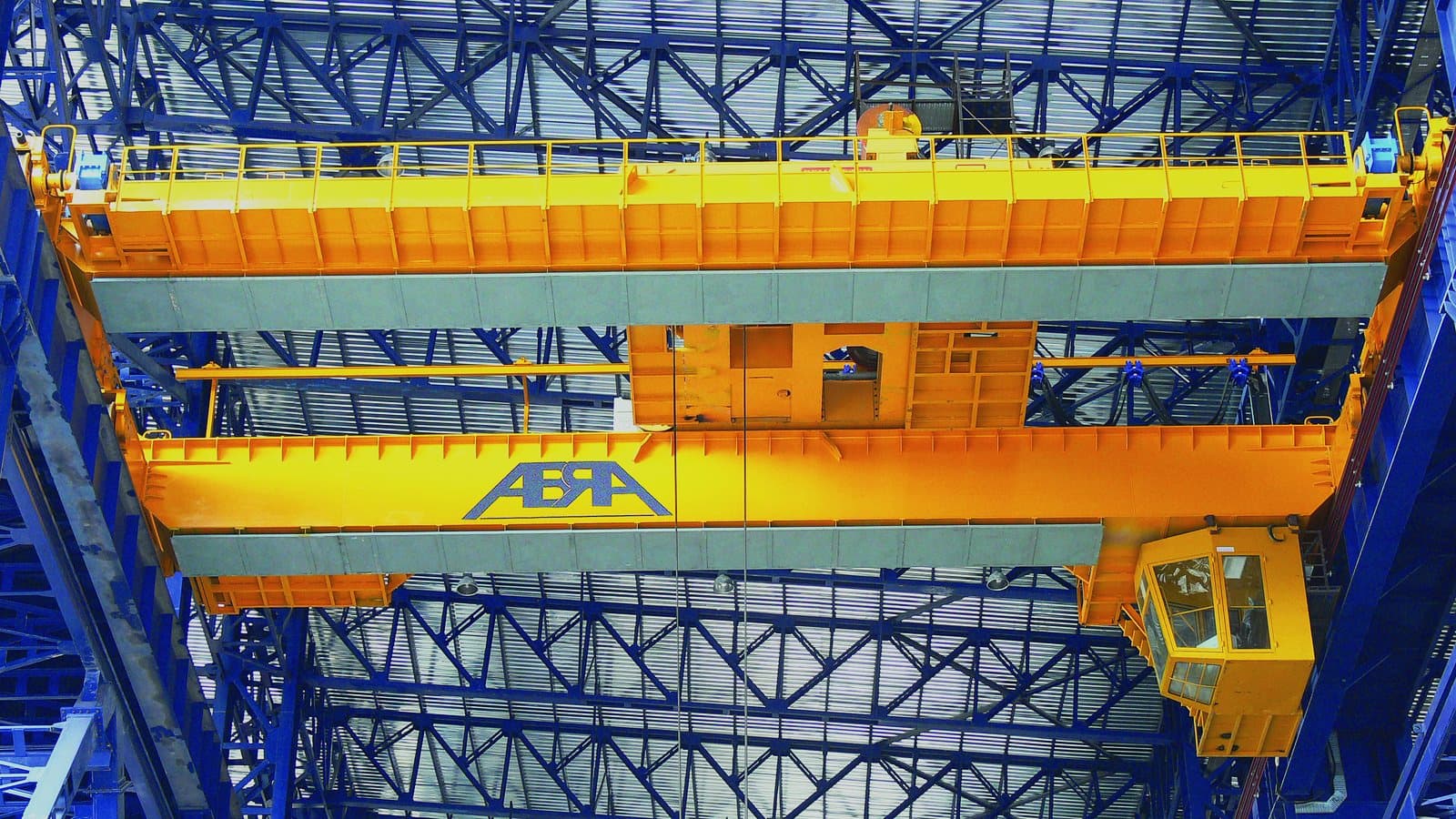
An overhead crane — also called a bridge crane or EOT (electric overhead travelling) crane — is a lifting machine carried on a bridge that travels along a runway above the working area. The bridge crosses the building, a trolley moves along the bridge, and the hoist lifts. Because it works overhead, the floor stays clear.

Type selection

How to choose: the four decisions

Almost every crane specification comes down to four questions, in this order.

STEP 1

What carries it?

If your building steel can take a runway, the crane hangs from the building and you are choosing between single and double girder. If it cannot, or the work is outdoors, the crane carries itself and you are looking at a gantry or semi-gantry. This decision comes first because it changes everything after it.

STEP 2

How much, over how far?

Capacity and span are not independent. A longer span lowers the capacity a given girder can carry, which is why we calculate the pairing per project rather than publishing a fixed matrix. Lifting height comes with them, set by your building and any pit below the floor.

STEP 3

How hard does it work?

This is the duty class, and it is the decision most often got wrong. It is explained in the next section because it deserves more than a line.

STEP 4

What is it working in?

Heat, dust, corrosive air, food or pharmaceutical hygiene, or an explosive atmosphere — each changes materials, protection and sometimes the whole certification route. An ATEX requirement in particular is not an option added later; it shapes the design from the first calculation.

Duty class (FEM / ISO), and why it decides the crane's life

The duty class is not a measure of how heavy your load is. It is a measure of how hard the crane works: your load spectrum — how often it lifts near capacity rather than well below it — combined with how many hours it actually runs.

That is why two cranes with the same 20-tonne rating can be completely different machines. One lifting 20 tonnes twice a shift is a light-duty crane. One lifting close to 20 tonnes every few minutes across three shifts, or in continuous process duty, is a high-duty crane, and it needs more steel, a bigger drum, a different motor rating and a shorter maintenance interval.

Get it wrong in the specification and the crane does not fail on day one. It fails years early, usually in the lifting machine, and the cost lands as unplanned downtime rather than as a capital line.

We size the class to your real cycle, and we state it in the documentation so it is verifiable rather than assumed. Our range runs from FEM 1Bm (ISO M3) to FEM 5m (ISO M8). There is a fuller explanation in the duty class guide.

Technical data

Capacity, span and lifting height

Read each value with its consequence — that is how the crane is actually sized for your building.

Our range covers 250 kg to 160 tonnes as a standard selection; above 160 t we engineer per project. Single girder cranes run to 12 tonnes as a standard selection, with a 30 m span as standard and lifting height to 30 m; above 12 t they are engineered per project. Double girder cranes run to 160 tonnes, reaching 32 m span at 100 t, with lifting height to 30 m. Gantry and semi-gantry cranes cover 12 tonnes on a single girder and 160 tonnes on a double girder, with spans of 32 m as standard.

Every one of those pairings is a maximum in one direction, not a matrix. The combination your building can actually run is calculated for your project.

Environment: heat, dust and explosive atmospheres

Our cranes are built for −10 to +50 °C ambient as standard, with motors and panels at IP54 / IP55 for dusty and damp industrial environments. Beyond that band the environment starts to drive the design.

Hot work — ladle handling, furnace charging, foundry cycles — moves you towards a process crane, where the heat, the cycle and the load spectrum are designed for together rather than treated as an option. Explosive atmospheres take you to an explosion-protected (ATEX) crane, engineered for gas Zone 1–2 and dust Zone 21–22 against the specific code on your site.

Applications

Where overhead cranes work

The crane follows the industry's lifting condition. Steel and metal service handles coil, billet and ladle at high duty. Foundries run hot loads on continuous cycles. Cement, energy and mining add dust and long hook paths. Shipyards and ports work long spans outdoors. Automotive, machine building, packaging and food handle lighter loads where accuracy and uptime matter more than tonnage. Chemical, petrochemical and pharmaceutical sites add the atmosphere on top.

Equipment

Equipment and options across the range

Overload protection (EN 14492-2)

An overload switch and load cell come as standard on every crane we build.

Inverter (VFD) control

Soft starts and stops, reduced load sway, less shock into the structure and the runway.

Assisted automation

Position memory, target positioning and anti-sway for repeatable moves, with the operator in control; see automated crane systems.

Operator cabins

Made in-house, fixed or travelling with the trolley; one control option alongside pendant and radio remote.

Crane control systems

Radio remote, pendant, inverter-based anti-sway and safety devices.

ABRA Crane Tracking

Usage, condition and maintenance data from the crane itself.

Built in-house, backed for life

Every serious maker builds an overhead crane. What differs is how much of it they actually make, and who is still there in year fifteen.

The lifting machine is built in our own plant alongside the steel structure, the end carriages and wheel groups, and the operator cab. That means one team is accountable for the whole crane, and when you need service, a spare part or a modernisation years later, you are talking to the people who made it.

After-sales

Maintenance, parts and service, we service it: scheduled maintenance (4 visits a year under contract), spare parts, modernisation and breakdown support across Türkiye within 48 hours of a call, and a 2-year warranty. We also service, supply parts for and modernise cranes of other makes. Crane Contact Center 444 8 440.

48 hoursOn-site response, anywhere in Türkiye
2 yearsWarranty, fixed term
4 visits / yearAnnual maintenance contract
Any brandService, spares and modernisation

FAQ

Frequently asked questions

What is an EOT crane, and is it the same as an overhead crane?

Yes. EOT stands for electric overhead travelling crane, and it is the term used most in Gulf and EPC specifications. Overhead crane, bridge crane and overhead travelling crane all describe the same machine: a bridge that travels along a runway above the working area, carrying a trolley and a hoist.

What are the main types of overhead crane?

Single girder and double girder cranes hang from a runway on your building steel. Gantry and semi-gantry cranes carry themselves on legs, so they need no building steel. Process cranes are designed around a process rather than a load. Any of them can be engineered as an ATEX version for an explosive atmosphere. Which one you need is usually decided by your building.

How do I choose between a single girder and a double girder crane?

They are two different structures, not two rungs of the same ladder. A single girder carries light to medium duty with less structure and less cost. A double girder is the answer when the load passes roughly 10 to 20 tonnes, when the span is long, when you need more hook path under the same roof, when the crane runs multi-shift cycles, or when an operator cabin, a maintenance walkway or purpose-built below-hook equipment has to sit on the crane.

What is a crane duty class, and why does it matter more than capacity?

The duty class describes how hard the crane works — your load spectrum combined with running hours — rather than how heavy the load is. Two cranes with the same rating can be entirely different machines because of it. A class set too low does not fail immediately; it fails years early, usually in the lifting machine. See the duty class guide.

Technical data

Technical data

Overhead crane types

TypeWhat carries itCapacitySpanChoose it when
Single girderRunway on building steel250 kg – 12 t30 m as standardLight to medium duty; economy matters
Double girderRunway on building steel250 kg–160 t32 m at 100 t, as standardHeavy loads, long hook path, cab or attachment
GantryIts own legs on floor rails12 t single / 160 t double32 m as standardNo building steel, or the work is outdoors
Semi-gantryOne runway, one leg12 t single / 160 t double32 m as standardOnly one side of the building can carry it
Process craneEitherPer projectPer projectThe process, not just the load, drives the design
Explosion-protected (ATEX)EitherPer projectPer projectGas Zone 1–2 or dust Zone 21–22

Range overview

ParameterValueConsequence / note
Overall capacity band250 kg – 160 tWorkshop spot lifting to heavy process duty
Single girder250 kg – 12 t · 30 m span as standard · 30 m lifting heightThe economical structure for light to medium duty
Double girder250 kg–160 t · 32 m span at 100 t as standard · 30 m lifting heightHeavy loads, longest hook path, cab and attachments
Gantry / semi-gantrySingle girder 12 t · double girder 160 t · 32 m span as standardCarries itself; no runway on the building
Duty classFEM 1Bm–5m (ISO M3–M8), per projectSized to load spectrum × running hours
Hoisting speedStepless, inverter-controlled — 0–4 m/min standard, coming down to 0–2.3 m/min at the top of the rangeStandard crane speeds; micro-speed for accurate setting
Motion controlInverter (VFD)Soft start/stop, reduced sway, gentler on the structure
Power supply380–415 V / 50 Hz (60 Hz for export)Matches local and export grids
Protection classIP54 / IP55 (motor + panel)Dust and moisture protection for industrial environments
Ambient temperature−10 … +50 °CCold-store to hot-process ranges
ControlRadio remote / pendant / operator cabOperator cab made in-house
Overload protectionOverload switch + load cell, standardThe crane refuses a lift beyond its rating
StandardsEN 13001 series · EN 15011 · EN 14492-2 · EN ISO 13849-1 / -2 · EN IEC 60204-32 · FEM 9.511 (complementary) · CE · ISO 9001Duty class stated per project
Directives2006/42/EC · 2014/30/EU · 2014/35/EU · 2000/14/EC. Machinery Regulation (EU) 2023/1230 applies from 20 January 2027; our compliance work for it is completeThe CE route today, and what replaces it

Duty class reference

FEM (mechanism)ISO MTypical useWhat it usually means in practice
1BmM3Light, single shiftOccasional lifting well below capacity
2mM5Medium/heavy, 1–2 shiftsRegular lifting, mixed load spectrum
4mM7Very heavy, 2–3 shiftsNear capacity, most of the working day
5mM8Continuous / severeProcess cycles that never stop

Get a recommendation

Not sure which crane type you need?

Send us the load, the span, the duty cycle and the environment. An engineer confirms the structure and the duty class with you before anything is quoted — no obligation.

Or call 444 8 440

Request a technical review

Your details are used only to answer your request

Designed and built to EN, FEM and ISO standards · CE marked · duty class defined per project (our build range: FEM 1Bm–5m / ISO M3–M8) · manufacturing in İzmir since 2004