444 8 440Request a review
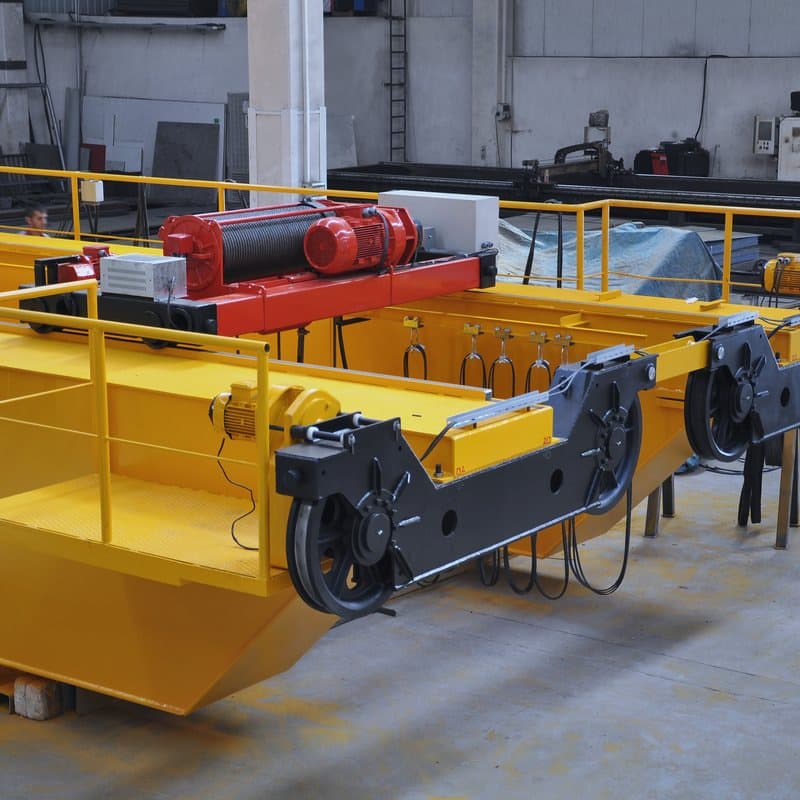
ABRA end carriage groups on a double girder crane at the ABRA plant

Crane Kits

You fabricate the girder and assemble the crane. We send a set whose hoist, end carriages, drives, panel and controls were engineered to work together — with the interface and load data you need to design the girder around them.

Matchedset, engineered together
Includedinterface data
Per projectduty class
Founded 2004EN · FEM · ISO designCE markedEurope · the Gulf · Africa · Central Asia · Latin America

What a crane kit is

A crane kit is a matched set of the components a crane is built from — hoist unit, end carriages, travel drives, control panel and controls — engineered to work together and supplied to a crane builder who fabricates the girder and assembles the crane locally. It is not a complete crane.

Overview

What is in the kit

A kit is configured per crane rather than picked from a shelf, and it normally contains:

  • The hoist unit — from our wire rope hoist range, with the trolley arrangement the crane calls for: double girder, underhung, or side-mounted.
  • End carriages, including the connection to your girder — this interface is what makes the set a kit rather than a list of parts.
  • Long-travel drive units — motor-gearbox groups, wheel groups and bearings.
  • The bridge control panel, with the protective devices: an overload switch and load cell come as standard on everything we build.
  • Controls — pendant or radio remote, and inverter (VFD) control where the duty calls for it. See crane control systems.
  • Bridge electrification — festoon or cable management along the girder.
  • Limit switches, buffers and end stops, and the fixings that go with the above.

Where the crane runs in a classified area, an ATEX version of the set is engineered to the site's own zone map and certified per project by a third-party notified body. See Explosion-protected cranes.

Kit scope

What you build, and what we send

The split matters more than the parts list, so here it is plainly.

We send the components above, configured for the crane you described, with their technical data, the connection details at the girder interface, and the loads the crane will transfer.

You build and provide the main girder and its fabrication and paint, the runway and its conductor line, the structural design of the runway and building interface, the assembly of the crane, its installation, load test and commissioning.

Both halves have to be true for the crane to work, and the second half is where a kit either saves a builder time or costs them a rework. That is why the interface and load data leave here with the set rather than after it.

Responsibility

Who is the manufacturer of the finished crane

This is the question that decides how a builder files the job, and the category answers it badly, so we will answer it directly.

The party who assembles the crane and places it on the market is the manufacturer of that crane. If you build the girder, assemble our components onto it and hand the crane to your customer, that crane is yours: you carry out the risk assessment for the finished machine, you compile its technical file, you issue its declaration of conformity and you apply the CE marking.

What we supply does not change that, and it is not meant to. A kit is a mixture: some items in it are complete machines in their own right and carry their own conformity documentation, while others are supplied for incorporation into your machine and come with the documentation appropriate to that. Our job is to give you what your technical file needs from us, and to be exact about which item is which.

A supplier who tells you the kit is "CE certified" and leaves it there has told you nothing useful, and has left the ambiguity on your side of the table.

Design data

The data you need to design the girder

The one thing a builder cannot produce without us is what our components do to their steel.

With the kit we issue the wheel loads and the forces the end carriages transfer, the wheel spacing and the connection geometry at the girder, the hook approaches and headroom the arrangement produces, and the duty class the set is configured to. Those are the inputs to your girder section, your camber and your customer's runway check.

Getting them at configuration rather than at delivery is the difference between designing a girder once and designing it twice.

Technical data

Duty class and capacity

Our wire rope hoists cover 250 kg to 160 tonnes as a family, in the BR23, BR30, BR33, BR36, BR46, BR58 and BR68 series, with the machine type set by the crane: double girder, underhung monorail or side-mounted. Machine-level duty is FEM 1Am (ISO M4) or FEM 2m (ISO M5) — the practical difference being 30% ED at 180 starts per hour against 40% ED at 240 starts per hour. At crane level the range runs FEM 1Bm to 5m (ISO M3 to M8), set per project.

Hoisting is stepless under inverter control, 2.3 to 8 m/min by series, reeving and duty class; trolley travel is stepless 4–16 m/min or fixed at 16 or 20 m/min. Supply is 380–415 V / 50 Hz, or 60 Hz for export, with IP54/IP55 protection and an ambient range of −10 to +50 °C.

The duty class is where most kit specifications go wrong, and it is worth settling before the capacity: a crane classed for the wrong duty is not a crane with the wrong hoist, it is a crane with the wrong life. The duty class guide sets out how it is determined.

Process

Working with us

The components in a kit are the ones we build for our own cranes, in our own plant — the hoist unit, the steel fabrication, the end carriages and wheel groups. That matters to a builder for one practical reason: when something has to change late, it is our drawing and our line, not a conversation with somebody else's supplier.

It also means the parts stay available. Spares for the components you fit are the same items we hold for our own installed base, which is the question a builder's customer asks in year six rather than in week one. See crane spare parts.

Technical data

Technical data

Table A — The boundary of supply

Supplied with the kitProvided by the crane builder
Hoist unit and trolley✓Per project
End carriages and the girder connection✓Per project
Long-travel drive units, wheel groups✓Per project
Bridge control panel, overload switch and load cell✓Per project
Controls (pendant / radio remote), inverter control✓Per project
Bridge electrification, limit switches, buffers, end stops✓Per project
Wheel loads, connection geometry, hook approach, duty class data✓Per project
Main girder — design detailing, fabrication, paintPer project✓
Runway beams and runway conductor linePer project✓
Structural design of the runway and building interfacePer project✓
Assembly of the cranePer project✓
Installation, load test and commissioningPer project✓
Risk assessment, technical file and CE marking of the finished cranePer project✓

Table B — Kit envelope

ParameterValue
Hoist capacity range (family)250 kg – 160 t
Hoist seriesBR23 · BR30 · BR33 · BR36 · BR46 · BR58 · BR68
Trolley arrangementsDouble girder · underhung monorail · side-mounted
Duty class — machine levelFEM 1Am (ISO M4) · FEM 2m (ISO M5)
Running time ratio30% ED · 180 starts/h · or 40% ED · 240 starts/h
Duty class — crane levelFEM 1Bm–5m (ISO M3–M8), per project
Hoisting speedStepless, inverter-controlled, 2.3 – 8 m/min by series, reeving and duty class
Trolley travel speedStepless 4–16 m/min; fixed 16 or 20 m/min
Lifting height (current selection tables)4–28 m
Reeving2/1 · 4/1 · 6/1 · 8/1 · 12/2
Overload protectionOverload switch + load cell, standard
Functional safety levelAt least PL c to EN ISO 13849-1; PL d or PL e where the project requires it
BrakeSpring-applied electromagnetic brake — closes when power is cut; release ≈ 0.3 s
Power supply380–415 V / 50 Hz (60 Hz for export)
Protection classIP54 / IP55
Ambient temperature−10 … +50 °C
ATEX versionPer project, gas Zone 1–2 / dust Zone 21–22, third-party certified
Span, capacity and configurationPer project
Documentation packagePer project
Configuration / selection tool for buildersPer project

FAQ

Frequently asked questions

What is included in a crane kit, and what do I still have to supply?

The kit is the hoist unit, end carriages with the girder connection, long-travel drives, the bridge panel with overload protection, the controls and the bridge electrification, plus the interface and load data. You fabricate and paint the girder, provide the runway and its conductor line, assemble the crane, and install, load-test and commission it.

Who is the manufacturer of a crane built from your kit?

You are. The party who assembles the crane and places it on the market is its manufacturer, which means the risk assessment, technical file, declaration of conformity and CE marking for the finished crane are yours. Our part is to supply components with the documentation your file needs from us, and to be precise about which item in the set carries which kind.

What data do I get for designing the girder?

The wheel loads and forces the end carriages transfer, the wheel spacing and connection geometry at the girder, the hook approaches and headroom the arrangement produces, and the duty class the set is configured to. They are issued at configuration rather than at delivery, because they are inputs to your girder design and your customer's runway check.

Will parts still be available in ten years?

The components in a kit are the ones we manufacture for our own cranes, so the spares your customer needs are the same items we hold for our own installed base. That is a different position from a kit assembled from parts bought in, where availability depends on somebody else's product cycle.

Get a recommendation

Send us a crane and we will configure the set

Capacity, span, lift height, duty, how it will be controlled and where it runs. You get the kit configuration, the wheel loads and connection data for your girder, and a clear statement of what arrives and what stays with you.

Or call 444 8 440

Span, site conditions, drawings or anything else that helps

We process the data in this form to answer your enquiry. Details: Personal Data Protection Notice · Privacy Policy.

Designed and built to EN, FEM and ISO standards · CE marked · duty class defined per project (our build range: FEM 1Bm–5m / ISO M3–M8) · manufacturing in İzmir since 2004