
444 8 440Request a review
Wall-Mounted Jib Cranes manufactured by ABRA Crane
Home › Industrial Cranes and Lifting Equipment › Wall-Mounted Jib Cranes

Wall-Mounted Jib Cranes

Spot lifting at the workstation without giving up floor space — the arm bolts to your wall or column and slews 180° over the work. We calculate what that puts into your structure before you order.

Made in-housemanufacturing in İzmir
180° slewing
Structural loads issued per project
Founded 2004In-house manufacturingEN · FEM · ISO designCE marked2,500+ cranes installed

What is a wall-mounted jib crane?

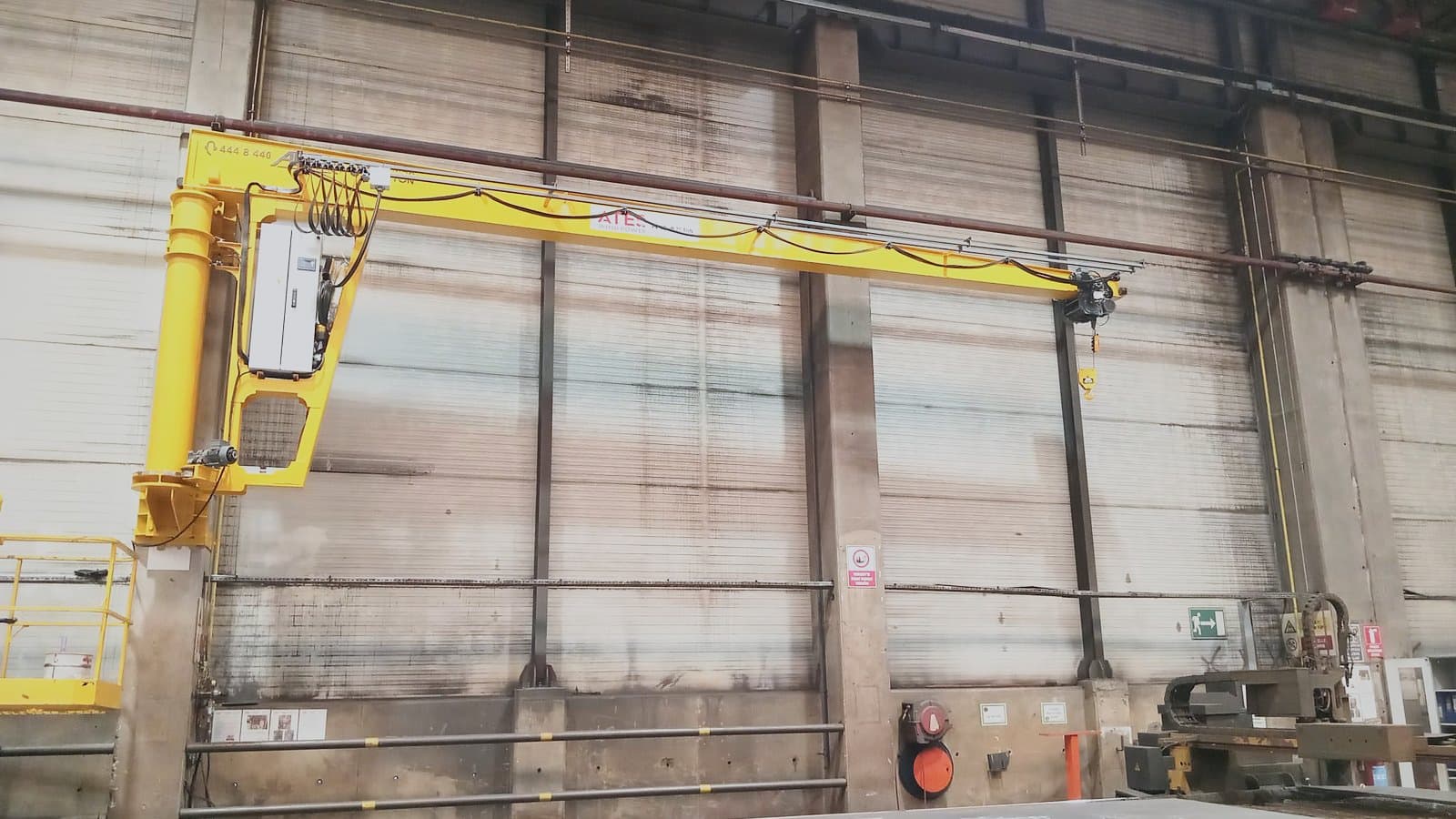
A wall-mounted jib crane is a slewing arm fixed to a wall or a building column, with a hoist running along it. Because it has no pillar, it takes no floor space at all. The arm slews about 180°, covering the work in front of the wall it is mounted on.

Type routing

Wall jib or pillar jib?

The decision is usually made by the floor rather than by the lift.

A pillar jib stands on its own foundation and slews 270°, or a full circle where it travels, so it covers work all around itself. It needs a concrete foundation and it occupies the spot it stands on for the life of the building.

A wall jib gives up the rear half of that circle and gets the floor back. It slews 180°, so it serves the strip in front of its wall — a machine, a bench, a loading position beside an aisle. Where the traffic pattern already runs along a wall, that half circle is the half you were going to use anyway.

There is a third case worth knowing about: if the work runs the whole length of the wall rather than sitting at one point, the arm can be put on a runway and travel along it. That is a wall-travelling (console) jib crane.

Type routing

What your wall or column has to carry

This is the question that decides whether a wall jib is possible, and it is worth putting before the crane specification rather than after it.

An arm fixed to a wall and loaded at its far end puts two things into the structure: a vertical load, and a bending moment that grows with the reach. A 3 m arm and a 7 m arm carrying the same load are different problems for your building. So the honest sequence is: reach and capacity first, structural loads calculated from them, and only then a decision about the fixing.

We calculate the load and moment transferred into your column or wall for your configuration and issue them with the quotation, so your structural engineer can verify the fixing before anything is ordered. Where the existing structure will not take it, that is better known at quotation stage than at installation.

Manufacturing

“From our plant to your wall”

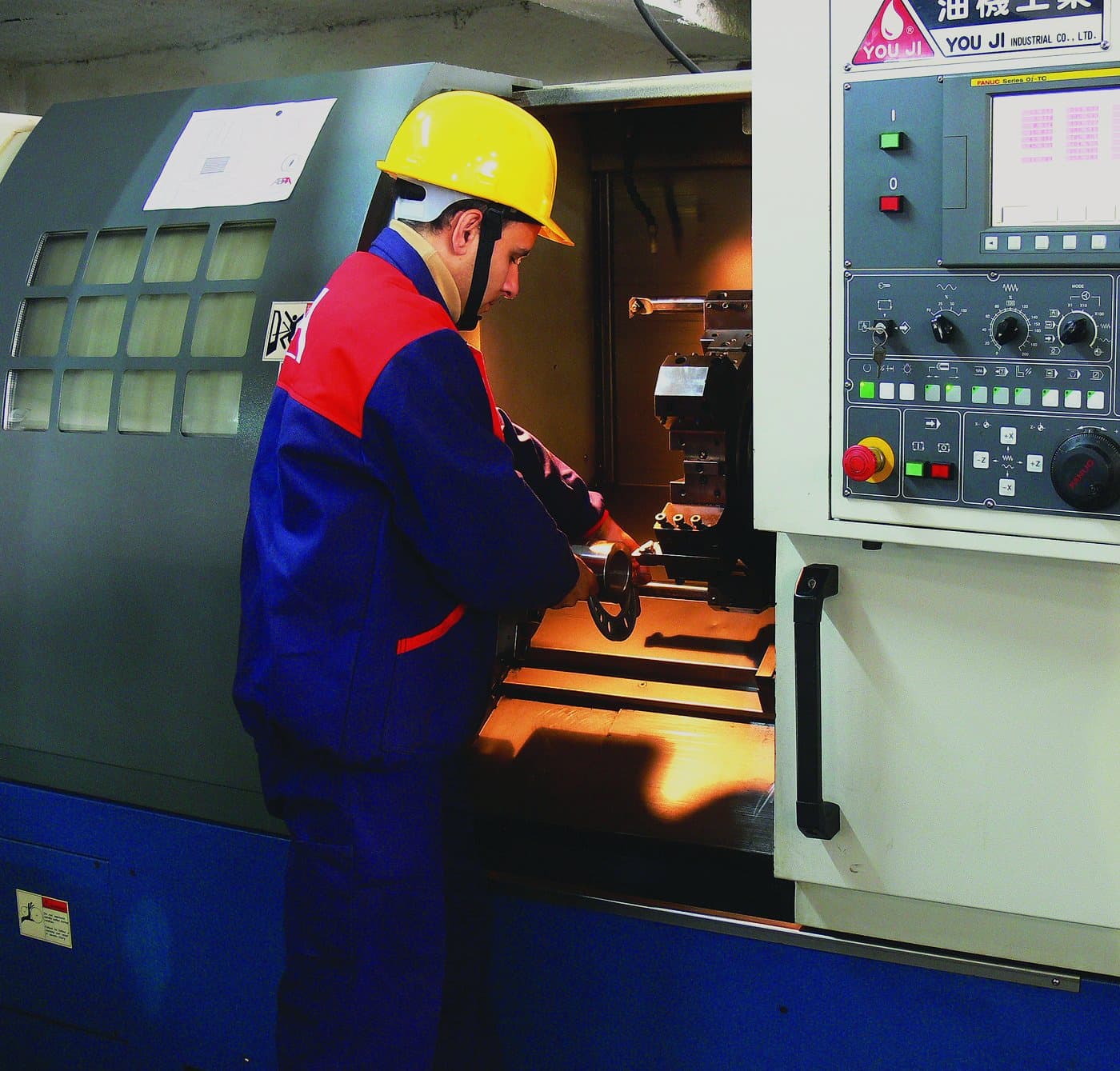
Machining at the ABRA plant in İzmir
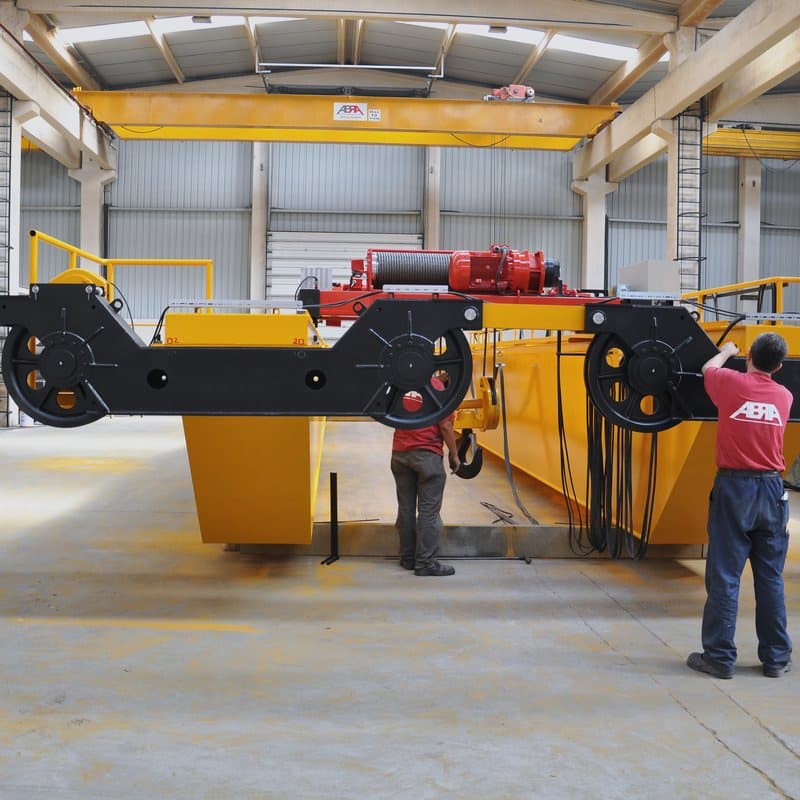
End carriage wheel groups machined at the ABRA plant
Hoist unit on test at the ABRA plant

Technical data

Technical specifications & capacity

Read each value with its consequence — that is how the crane is actually sized for your workstation.

Our jib crane family covers 250 kg to 5 tonnes on a wire rope hoist, and the wall-mounted type sits in the same selection table at 180° slewing. What your own wall will carry is confirmed per project, because the bracket puts its load into your structure rather than into a foundation. Arm reach runs from 2.5 to 5 metres, and reach is the value that drives everything else — it sets the working circle, the loads into your structure and how the crane feels to swing by hand. Wall-mounted units slew 180°.

Wall jib vs pillar jib

CriterionWall-mounted jib cranePillar (column) jib crane
Floor space usedNoneFoundation and the footprint of the column
Slewing angle180°270°, or n×360° on a travelling column
CoverageThe strip in front of its wallA full working circle around itself
FoundationNone — fixed to wall or columnConcrete foundation with anchor layout
What has to be checked firstLoad and moment into the wall or columnFoundation loads and concrete class
Typical reason to chooseFloor must stay clear; work sits along a wallWork is all around one point; no wall available
ABRA pagethis pagejib cranes

Wall-mounted jib crane — technical spec

ParameterValueConsequence / note
Lifting capacity (SWL)Jib family: 250 kg – 5 t on a wire rope hoistThe wall type is in the same selection table; what your wall carries is confirmed per project
Arm reachJib family: 2.5–5 m standard; above 5 m per projectReach drives the working circle and the loads into your structure
Slewing speed (motorised)1 rpmHand slewing is set by the operator
Trolley travel along the arm4–16 m/minMatched to the reach and the cycle
CoatingC3 indoor · C4 outdoor, to ISO 12944Set from where the crane stands
Slewing angle180°Serves the strip in front of the wall
Slewing driveManual or motorisedManual suits short reach and occasional use
Duty classDefined per projectSized to how often and how heavily the station actually lifts
HoistingWire rope hoistSee hoists
Motion controlInverter (VFD) on the hoistSoft start/stop, less swing on setting down
Overload protectionOverload switch + load cell, standardThe crane refuses a lift beyond its rating
Power supply380–415 V / 50 Hz (60 Hz for export)Matches local and export grids
Protection classIP54 / IP55 (motor + panel)Dust and moisture protection for industrial environments
Ambient temperature−10 … +50 °CCold-store to hot-process ranges
Load and moment into the structureCalculated and issued per projectYour structural engineer verifies the fixing before ordering
Hook height / clearancePer projectSet by mounting height and arm profile
ControlPendant / radio remoteChosen by where the operator stands
StandardsEN 14985 · EN 13001 series · EN 14492-2 · EN IEC 60204-32 · CE · ISO 9001Duty class stated per project

The speeds shown are standard values; other speeds are provided on request. Where a value depends on your site, it is written “per project” and confirmed with you.

Equipment

Equipment & options

Each option answers a specific problem, not a feature list:

Wire rope hoist

Sized to the load and the duty the station actually runs, not to the top of the range. See hoists.

Manual or motorised slewing

A manual arm is pushed by the operator and is right for short reaches and occasional use; motorised slewing earns its place on long arms, heavy loads or repeated cycles.

Inverter (VFD) control on the hoist

Soft starts and stops, so the load does not swing when it stops.

Overload protection (EN 14492-2)

An overload switch and load cell come as standard, so the crane refuses a lift beyond its rating.

Control

Pendant push-button or radio remote, depending on where the operator needs to stand.

Hook height and clearance

Set by your building; the arm profile and mounting height are chosen so the hook clears the work at full reach.

Applications

Where wall jib cranes work

Wall jibs earn their place where the lifting is local and the floor is busy. Machining and manufacturing areas use them to load and unload a single machine without a forklift crossing the aisle. Assembly lines use them at a station where parts are lifted into a fixture. Warehouses and workshops use them beside a door or a loading position where a pillar would block the traffic. And in a building that already has an overhead crane, a wall jib handles the small, frequent lifts so the main crane is not tied up on them.

Project process

How we work: from enquiry to commissioning and service

STEP 1

Tell us the workstation

(load, reach needed, what the arm is fixing to, how often it is used) → 2. Engineering & quotation (we confirm the reach, the hoist and the duty class, and issue the loads your structure has to carry) → 3. Manufacturing & installation (the arm and bracket are built in our own plant, then installed and load-tested on site) → 4. Maintenance & service (scheduled maintenance under an annual contract, spare parts and modernisation).

After-sales

Maintenance, parts and service, we service it: scheduled maintenance (4 visits a year under contract), spare parts, modernisation and breakdown support across Türkiye within 48 hours of a call, and a 2-year warranty. Crane Contact Center 444 8 440.

48 hoursOn-site response, anywhere in Türkiye
2 yearsWarranty, fixed term
4 visits / yearAnnual maintenance contract
Any brandService, spares and modernisation

FAQ

Frequently asked questions

What is the difference between a wall-mounted jib crane and a pillar jib crane?

A pillar jib stands on its own foundation and slews 270°, or a full circle where it travels, so it covers work all around itself. A wall jib is fixed to a wall or a building column, slews 180° and takes no floor space at all. Where the work sits along a wall and the floor has to stay clear, the wall version is usually the better fit.

How much can a wall-mounted jib crane lift, and how far does it reach?

Our jib crane family covers 250 kg to 5 tonnes on a wire rope hoist, with an arm reach of 2.5 to 5 metres. The combination that works on your wall depends on what the structure can carry, which we calculate for your configuration.

What does a wall jib crane do to the building structure?

It puts a vertical load and a bending moment into the wall or column it is fixed to, and the moment grows with the reach — a 7 m arm is a very different case from a 3 m one at the same capacity. We calculate the load and moment for your configuration and issue them with the quotation, so your structural engineer can verify the fixing before anything is ordered.

Can a wall jib crane work under an existing overhead crane?

Yes, and that is one of the common reasons to fit one. The wall jib handles the small, frequent lifts at a station while the overhead crane stays free for the work that actually needs it. The clearances between the two are checked at the design stage so the arm and the bridge never contest the same space.

Get a recommendation

Talk to an engineer about your wall jib crane

Send us the load, the reach you need and what the arm would fix to. An engineer confirms the configuration and issues the loads your structure has to carry — no obligation.

Or call 444 8 440

Request a technical review

Your details are used only to answer your request

Designed and built to EN, FEM and ISO standards · CE marked · duty class defined per project (our build range: FEM 1Bm–5m / ISO M3–M8) · manufacturing in İzmir since 2004